
A record of where the equipment has been. Not a claim about where it is.
Four verbs: create, pick up, put back, service. Every machine carries a printed label with a QR and six characters. Anyone may scan it, signed-in staff move it, a technician records what they found, one shared room carries what the floor has to say about any of it, and nothing that reaches the event log can ever be edited afterwards.
This page changed again in September 2026.
The module is built: the corridor console, the administrator surface on the host machine, three signed-in roles, sealed service notes, a recall workbench fed by Health Canada's daily feed, a printable device history, and twenty-one screens that clear WCAG 2.0 and 2.1 Level A and AA with zero violations. Three claims that used to be on this page were wrong. Each was removed rather than quietly reworded, and the sections below say which and what replaced them. The last section says what the module still has not had.
No sign-in wall between a person and the thing in front of them.
Equipment gets a label carrying a QR and a six-character public code, random and fixed for the life of that machine. Anyone who scans it, a porter, a nurse, a visitor, a contractor, sees what the thing is and whether it is in service. No account, no sign-in wall.
They do not see where it is or who has it. That rule decides which columns are encrypted, and it is one sentence long: what this system prints on a sticker stuck to the outside of a machine, in a public corridor, is not a secret. The name, the hospital tag and the home location stay readable. The serial number, make, model, firmware version, service vendor, contract reference, description and photograph do not.
The hospital's own existing asset number stays on the record and is never replaced. A system that renumbers a hospital's equipment estate to suit itself has made the hospital's problem worse in exchange for its own convenience.
A sealed column that has to be searchable carries a blind index. The serial number is stored as an HMAC of its normalised value under a key derived from the primary key, which makes serial search exact rather than partial. The interface says so on the search field, because a search box that silently will not do prefix matching is a search box people stop trusting.
Three custody states, and a fourth that was deleted.
An earlier version of this module had five, including one called unconfirmed and one called lost. Both went, because both were the system dressing up an absence of information as a finding. What remains is the smallest set that can be true.
AVAILABLE
Nobody is holding it. The only state it can move to is checked out.
CHECKED_OUT
One named person took it and named a place. Somebody else may take it from them, which is written as a check-in and a check-out inside one transaction, so both halves land or neither does. You cannot, however, take it from yourself: that was a real defect, and the fix is a test.
OVERDUE
Held past the hour limit its category carries, and nothing more than that. It is not lost, not missing, and not overdue in the maintenance sense. It still names a holder and it still says how long it has been.
UNCONFIRMED
Deleted. A state that exists because time passed is a state the system invented, and it made an administrator's screen look like an investigation had happened when nothing had happened at all.
LOST
Deleted with it. Whether a machine is gone is a conclusion somebody reaches by walking a floor, and this product does not have a floor.
What it prints instead. Last left at Tower 4, Clean Utility, three days ago. It never prints currently in Tower 4. The system did not watch the machine after somebody put it down, and saying otherwise is the lie every tracking system tells first. The phrases real-time, live location and current location are refused by a test that runs on every commit.
Nearest first, from where you are standing.
Where is the closest free infusion pump to the cath lab is the question a nurse asks at three in the morning, and answering it by reading the whole fleet list by eye is how somebody ends up at an empty hook two floors away. It is a checkbox on the list already in hand rather than a second screen with its own picker, because it is the same search with one more constraint on it.
The order comes from the wayfinding graph. One pass out from where the person is standing gives the walking distance to every node in the building, so ranking the whole fleet costs one traversal rather than one per machine. Same graph, same closures, same physical scale as the map a visitor is reading downstairs, which is the reason these are two pillars of one product rather than two products. A corridor an operational notice has taken out of routing is taken out of this answer too.
It ranks where a machine was last left
Not where it is. Every row carries the date of the scan it is standing on, and the answer is only ever as good as the last person who named a place. The minutes it prints are the modelled walk, at the same deliberately slow pace the reader's map quotes.
A short list is not a small fleet
Machines with no place recorded are counted separately rather than dropped, and so are the ones the router could not walk to. Four more and nobody knows where is information; leaving them out silently would make the fleet look smaller than it is.
The map is an enhancement, never a dependency
A hospital that wants the equipment record and no map still gets the whole list. The distances are simply absent, one line on the screen says so, and the ordinary order stands.
The technician's half
01 / What is due
Counts, never a percentage.
Six need service. Two have never been serviced. A percentage is a grade, and a grade points every incentive in the building at moving the number rather than servicing the machine. A count has no denominator anybody can argue about, and the word compliant never appears, because this system records evidence and does not adjudicate.
02 / Record it
One named schedule, completed by one named person.
Servicing is the only event that advances a schedule, and it carries which task it was. A porter tapping something is not evidence of maintenance, which is why clinical staff cannot write this and a technician can. Equipment may carry several schedules, and each is its own obligation with its own clock.
03 / Say what you found
A null answer is a real answer, and it is not "fine".
A condition note is the technician's own words and it is required. A replacement grade is one of three, with a reason, and it is also required. No grade at all means nobody has looked, which is a different fact from somebody having looked and said it is fine. A report that cannot tell those apart tells an administrator an unexamined fleet is healthy.
04 / Fix a mistake
Strike it out. Never delete, never edit, never undo.
A wrong entry is voided by a correction naming the row it supersedes, and the correct fact is recorded fresh. The struck row stays visible forever with a rule through it and the reason underneath, because the pair is the correction. An administrator cannot edit this log either. Nobody can.
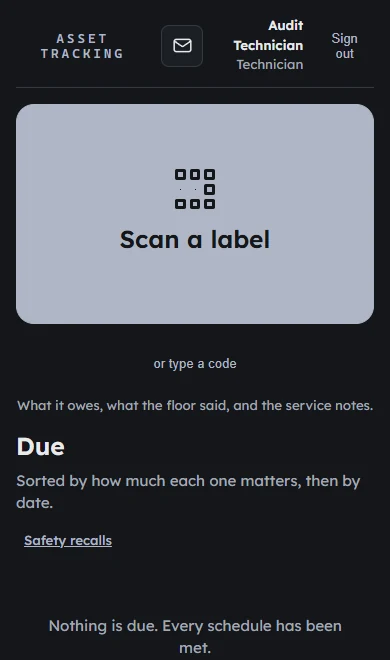
One label. Two answers. Two routes with two guards.
A nurse who scans six characters and a technician who scans the same six characters need almost nothing in common. Rather than one handler branching on a flag, there are two routes behind two guards, because an authorisation mistake should be a refusal rather than a rendering bug.
The nurse gets a door
What the thing is, whether it is in service, and one button sized like a door: Take it. Nothing blocks her. Equipment somebody else is holding can be taken, and equipment a technician has taken out of service can be taken too, with the reason shown loudly first. A block is a block somebody works around by not using the app, and then nothing is recorded at all.
The technician gets the record
What the machine owes, what the floor has said about it, whether opening the case ends its warranty, the firmware version a recall is written against, and the service notes. Custody is demoted to a plain button underneath all of it, because taking a pump is not what a technician came to this screen to do.
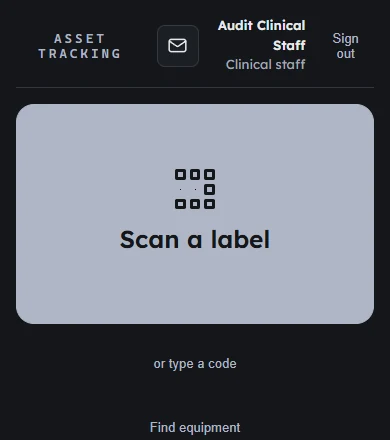
The floor can say something, and only a technician can decide what it means. A nurse who finds a broken pump presses one button, types a sentence, and it lands in the shared equipment room with her name on it. It changes nothing about the machine: taking equipment out of service is a technician's judgement, and a report is not a verdict. The card warns while a report is unanswered and never blocks, because a nurse at three in the morning with one pump in the building makes her own decision with the facts in front of her.
Messages
She can name the machine inside the sentence.
One room, and the whole hospital is in it. Nurses, doctors, porters and environmental services write; technicians and administrators read it and answer. It replaced a technicians-only inbox, because a queue two roles are responsible for is a queue neither of them clears.
A message may carry equipment, and the machines sit where the writer put them, mid-sentence, at the cursor. Tapping one opens its profile. The position is stored as a token inside the sealed text rather than as a table of offsets, so it cannot drift when somebody edits a word in front of it: the token is its position.
Resolution is per machine, not per message. A technician who services one of two pumps has answered that message for that pump and no other, so a single flag on the whole message would be wrong for at least one machine on it. Naming several is what a person actually writes, and the record has to survive being written to that way.
Nothing here pages, texts or phones anybody, and there is no urgency flag of any kind. The composer says it plainly: read when the equipment team next opens this, and if it cannot wait, phone them. The one number that ever reaches zero is unread, counted per person.
One mail icon, and still no tab bar. This console has never carried persistent navigation, because a bar for four destinations is a navigation concept charging rent. An icon carrying the unread count is narrower than a bar, and it is the one way into the room, on every screen, at forty-eight pixels. The technician's home lost its old inbox button the same day: two controls with one name is ambiguous to anybody navigating by voice, and its own test found it by refusing to choose between them.
J. Okafor · Clinical staff · 03:14
Both volumetric pumps in 4B stopped mid-infusion on nights. 7F3K9M did it twice and BQ2H4T once. Left both by the clean utility door.
◆ 1 of 2 still open
R. Vasquez · Technician · 09:02
7F3K9M serviced and back on the floor. BQ2H4T is out of service until the part lands.
7F3K9M resolved by R. Vasquez
Illustrative, not data from any deployment. Servicing one of the two pumps closes this message for that pump and leaves the other open.
The record learns that a report was made. It never learns the words.
Tagging a machine writes an append-only line on its event log naming who reported it and when, with a link to the message and no text on it. The sentence lives in exactly one place, so an author's edit cannot create a second version of a safety report, and a deletion cannot leave an orphan copy sitting on a permanent record.
Eight digits in a row raise a warning, and never a block.
A long run of digits is the shape of a health card or a chart number, and the composer says so before the message is sent. The warning is suppressed when those digits match the tagged machine's own serial, hospital tag or public code, because an app that cries wolf about its own numbers teaches people to dismiss it. The writer chooses: send anyway, or go back and fix it.
Side rooms: the existence is public, the contents are not.
Technicians and administrators open a side room and choose who is in it. Everybody sees the room list; only members read what is in it. A machine named in one shows a locked stub on its record: the room's name, how many people are in it, when it was first mentioned, no words and no way in. Banning the tag would have hidden the link without stopping the conversation.
Any administrator may let themselves into any side room, and the room says so.
The administrator is the only account that can remove somebody else's message, which is the only answer this system has to patient information appearing in a shared room. That power is worth nothing if the rooms where private conversation actually happens are closed to it, so entry is allowed and every entry posts a line naming who walked in.
Twelve months, then the words go and the rows stay.
A nightly sweep empties the body of any message nobody has left open, and of everything in a closed side room. The rows survive: the log line, the attribution and the side-room stub are permanent, because who said something and when is the half of a private conversation a record can honestly keep. The window is the hospital's own setting, and setting it to zero turns the sweep off.
The host console answers as the equipment office, not as a person.
An administrator replying from the loopback console posts under Equipment office, with a line saying no person is named, because that console runs without sign-in by default and a signature nobody stands behind is worse than no signature. An administrator who signs in from a ward phone posts under their own name, in the same room.
This is the part of the module standing furthest out. Free text, typed by hundreds of people, read by every account holding any equipment role, on a branch whose whole premise is that it holds no patient record. Three things stand there: the digit warning, an administrator who can destroy the text of somebody else's message, and the twelve-month sweep. None of the three has met a real hospital. The argument for building it anyway is that this conversation already happens, on paper and in corridors, where no record of it exists at all.
Health Canada publishes a recall every day. Somebody has to ask whether it is one of yours.
A daily sweep reads the public recall feed and matches it against the equipment register on make, model and firmware version, which is precisely what the profile fields were collected for. What it produces is a list of candidates and a decision to make about each one. It is not an alert, and it does not change the state of any machine.
It says "may be affected", and a test says so too
The screen never says a unit is recalled, or unsafe, or out of service. It says the model matched and names the class Health Canada assigned. The words the screen must not print are asserted absent by a test, in the same way the rest of this product's vocabulary is held.
Three answers, and one of them is "not us"
We hold this unit, Not us with a reason, or print the equipment record to take into the conversation. A dismissal is recorded with its reason rather than vanishing, because "we checked and it was a different production run" is a fact somebody will need again next year.
The plate says what it cannot show
Affected units are marked on a schematic floor plate, and it is schematic on purpose: a diagram that looks surveyed invites somebody to navigate by it. Units with no mapped home are listed beside the plates under a heading saying they are not on the map, with whatever free-text home they do have. Nine of twelve units drawn with no note is a worse answer than drawing nothing, because it looks complete.
The marker is not red
It uses the colour this product gives to "due", not to "out of service". Nothing here is an emergency; every unit on the plate is a candidate awaiting a human decision, and colouring it like a hazard would be the map telling a lie the text is careful not to.
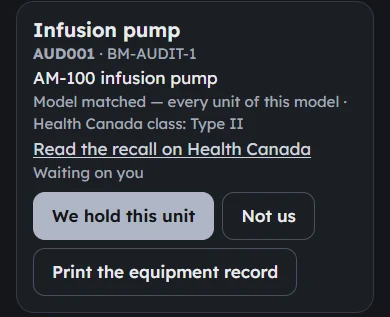
The sweep fetches from an allowlist, and that was a fix. The first version followed whatever URL the feed handed it, including across a redirect, which makes a public feed into a way to point this system at any address on the network it sits in. A redirect leaves the allowlist by definition, so it is refused rather than followed.
A surveyor points at a pump and asks where it came from.
Today that answer gets assembled from a spreadsheet and somebody's memory while the surveyor waits. Scanning the sticker produces the same answer as a PDF: where the machine came from, everyone who has held it, every service recorded against it, every correction, and the provenance of every line on the page.
Counts, and the reason printed beside them
The fleet section reads "14 overdue, 6 never serviced, 212 in schedule" and no ratio appears anywhere, because the shape of the data has no field to put one in. The pack says why on its own face: the first question a reader asks of five numbers is "so what is the compliance rate", and a single percentage flattens "never serviced once" into the same bucket as "two days late".
Corrections are in it
A device history that hid its corrections would be the opposite of a device history. Struck entries appear alongside services and custody, the people are resolved to names rather than printing an identifier at somebody holding a clipboard, and a history long enough to be cut says it was cut instead of implying it is complete.
Service notes are not in it, and it says so
The pack prints a line stating that service notes exist for this machine and are not included, rather than omitting them silently. A surveyor who is not told will assume the history in front of them is complete, and a silent omission in a document produced for an auditor is the worst kind there is.
Producing one is a disclosure
The pack carries custody history, which names staff, and it leaves the building on paper or as a file. So generating one is audited like any other disclosure. The record of who produced it is the thing that makes it defensible afterwards.
Every page says what it is
Facility, equipment code, timestamp, who generated it and the build version are stamped on each page, so a sheet separated from its pack still identifies itself. Paper gets separated. That is what paper does.
A draft is still a 404
Equipment whose label was never printed answers exactly as the anonymous scan card does: nothing. Holding a technician role is not a reason to confirm that a record exists behind a code that was never printed on anything.
Three roles, one nightly job, and a fourth role that was removed.
This page used to describe an independent auditor with an audit period, a sign-off and findings. All of it was built, shipped, and then deleted, because in a department with four technicians the auditor was one of the four, and a role that only ever exists on paper puts a signature line under a document nobody independently checked.
| Role | Who they are | What they may write | Where they work |
|---|---|---|---|
| ADMIN | Department or biomedical manager. | Adds equipment, prints labels, sets schedules and equipment access. Answers in the equipment room as the equipment office. Reads every service note and still cannot save one. | Host console only |
| TECH | Technician. One word, not three. | Records that a named schedule was completed, writes the condition note and the replacement grade, takes equipment out of service, and answers the floor in the equipment room. | The corridor |
| STAFF | Nurse, doctor, porter, environmental services. | Takes equipment and puts it back, naming a place each time. Writes in the equipment room and may name machines inside the sentence. Nothing that constitutes evidence of maintenance. | The corridor |
| system | The nightly job. Never a staff account. | Ages custody past its hold window, and nothing else. Writes as a literal actor with no relation behind it. | No screen |
| anonymous | Anyone with a phone and line of sight to a label. | Nothing. Reads what the machine is and whether it is in service. | The scan card |
Why a technician role exists at all
The two-role design a hospital usually asks for, an administrator and everybody else, has nobody whose signature on a maintenance record means anything. That record is the spine of the module. If clinical staff can write it, the resulting count is decoration.
Why the administrator moved off the network
Adding equipment, printing labels, the equipment board, the fleet report and equipment access all live on the host console, which is bound to loopback. They are unreachable through the tunnel by design, not by configuration. The corridor keeps four verbs and nothing else.
This page used to claim end-to-end encryption here. It never worked once.
Until 7 September 2026 each machine's service notes were encrypted in the
technician's browser under a facility passphrase the server never received,
and this section described that scheme at length, limits and all. The panel
that set the passphrase was gated on an equipment authority that first-run
setup never granted to anybody. Every attempt answered 403 and
showed "Did not save. Try again." Zero keys and zero notes were ever
written, on any installation, for the entire life of the feature.
The honest thing to say about a security property that was never exercised is not that it was strong. It is that nobody would have found out. The ceremony was removed rather than repaired, and what replaced it is written below along with what that trade actually cost.
What it is now.
One document per machine, AES-256-GCM under the same application keyring that seals every other note in the product, with the machine's own identifier bound into the tag. A copy of the database yields ciphertext and nothing else, and the key is held in the environment rather than beside the data.
What was given up, and it is real.
The server can now decrypt what it stores. Under the old design it could not. That is a genuine property to lose, and it is listed first rather than last because a reviewer will find it either way.
Why losing it was worth it.
It protected notes about machines, on a branch that holds no patient data at all. It was bought with a shared secret every technician had to be told, which is a secret that ends up written on the wall beside the thing it unlocks, with no way to revoke one person without rotating for everybody. And a facility that forgot the string lost every note in the building, permanently, with no escrow and no recovery.
What was kept unchanged.
Notes cannot be moved between records: pasting one machine's document onto another produces a decryption failure rather than a plausible wrong answer. Technicians write, every floor role reads, and an administrator who may read every note may save none. A save carries the revision it read, so two technicians cannot silently overwrite each other. The audit line still records that a note was written and still carries none of its words.
Feature-complete, and it has never run in a hospital.
Both halves of that sentence are load-bearing. The first is a genuine change from what this page said in August. The second has not changed at all, and no amount of building is going to change it.
What is built
- The four verbs, and the corridor console rebuilt around one decision per screen.
- The administrator surface, on the host machine, unreachable from the network.
- Three signed-in roles, the nightly job, and anonymous scanning.
- The append-only event log, with corrections that strike out rather than delete.
- Encrypted profile fields, a blind index on the serial, and sealed service notes.
- Twenty-one screens across all four apps at zero WCAG 2.0 and 2.1 A and AA violations.
- An ASVS Level 2 self-assessment, and the two findings writing it exposed.
- One equipment room the whole hospital writes into, with private side rooms beside it.
- Nearest first, ranked on the same graph and the same closures the visitor's map uses.
- A daily sweep of Health Canada's recall feed, matched against the register, with a workbench for the decisions.
- A printable device history, produced from a scan and audited as the disclosure it is.
What it has not had
- A corridor. Nothing here has met a real floor, a real trolley or a real night shift.
- A printer. Labels have never been produced by hospital hardware and stuck to a real machine.
- A technician who did not help design it, using the due list on their own shift.
- A year. Schedules have never survived twelve months of real drift, staff turnover and a recall.
- A budget meeting. Nobody has yet read the fleet report while deciding what to buy.
- An independent audit. The accessibility and security results above are the project's own.
- A room with people in it. Nobody has yet typed anything into the equipment room that a hospital would mind being read.
Three things this page used to say that were wrong. It described an independent auditor role, which was built and then deleted for the reason given above. It said an unauthenticated sighting could raise an item in a queue for confirmation, which should not have survived the rebuild: anonymous scanning writes nothing at all. And it described the service notes as end-to-end encrypted, which was true of a design that never once ran. All three are corrected in place rather than quietly removed, on the same principle the event log runs on.
The next thing this module needs is a corridor.
A pilot in one department, with real machines, real labels and a technician who will tell us which screen is wrong. A briefing walks through the data model, the roles, the encryption boundary and this whole list of what it has not had.